- The Wichita Weekly
- Posts
- 🌻 Wichita Had the First Electric Guitar?
🌻 Wichita Had the First Electric Guitar?
The first recorded public performance with one, at least!
Good morning, Wichita!
As always, please forward to someone that might find this post interesting! Thank you!
I’m a big music fan — though I tend to lean into the acoustic side of things (love me some banjo and mandolin). However, there are times when the soul needs a bit of crying electric guitar — and surprisingly, we can thank Wichita for giving it to us!
That’s right. Wichita is more than the Air Capital of the World — it’s also where the electric guitar first plugged into American culture.
Long before Marshall stacks, tube amps, and rock legends electrified global stages, something remarkable happened right here. In October 1932, a local bandleader named Gage Brewer brought the first electric guitar out of the lab and into the spotlight — kicking off a revolution in music that would eventually reshape genres from blues to rock ’n’ roll.
PERFORMER MEETS INVENTION
Gage Brewer’s Hawaiian Guitar
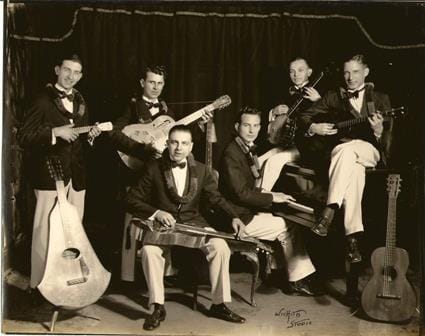
Wichita owes this piece of history to Gage Brewer, a bandleader, guitar instructor, and radio personality who called Wichita his home.
Brewer was deeply immersed in Hawaiian guitar, which was wildly popular at the time. Slide guitars, steel guitars, and exotic tunings filled dance halls and radio broadcasts across the Midwest. Wichita, growing fast thanks to aviation and manufacturing, was a perfect place for a musician willing to try new things.
But Brewer had a problem — like many guitarists at the time — because early 20th century guitars were quiet instruments. In dance orchestras, they were easily drowned out by horns, pianos, and drums. Guitarists were often relegated to rhythm roles or replaced entirely by banjos, which were louder and cut through the noise of other instruments better.
Musicians and inventors had been experimenting with amplification for years, but nothing had truly worked — until a small group of tinkerers in California changed the equation.
In the early 1930s, George Beauchamp, working with engineers who would soon form the Rickenbacker company, created instruments that didn’t rely on resonating wood alone but instead used electromagnetic pickups to capture string vibrations and amplify them into orchestra-sized sounds.
The earliest successful instruments were electric steel guitars, including the famous aluminum “frying pan” models. These weren’t meant for rock stars (that concept didn’t exist yet). They were designed for working musicians who simply wanted to be heard.
In September 1932, Gage Brewer traveled to California and encountered these instruments firsthand. He immediately understood their potential — not as novelties, but as tools that could change live music.
Brewer purchased two of these “electro steel guitars.”
THE PERFORMANCE
Halloween Night 1932

The big reveal came in October. The Wichita Beacon reported Brewer had returned from California with a “new and revolutionary musical instrument” — the electro steel guitar — and was featuring it at the Shadowland Dance Hall (a dance hall owed by Brewer himself and famous for being a strict no alcohol spot!)
On Halloween night, he plugged in and, as far as historians can determine, played the first documented public performance of an electric guitar anywhere in the world.
The audience reaction was part awe, part confusion. Some reportedly wondered whether Brewer might be shocked while playing. Others were simply stunned that a guitar could suddenly compete with an entire orchestra.
But it is no accident that this happened in Wichita.
In the early 1930s, Wichita was a regional media hub, with active radio stations, dance halls, and touring circuits. Musicians passed through constantly. Ideas spread quickly.
Brewer used Wichita radio to promote the new instrument, introducing listeners across the region to amplified guitar sounds years before electric guitars became commercially common.
THE GUITAR
Wichita-Sedgwick County Historical Museum
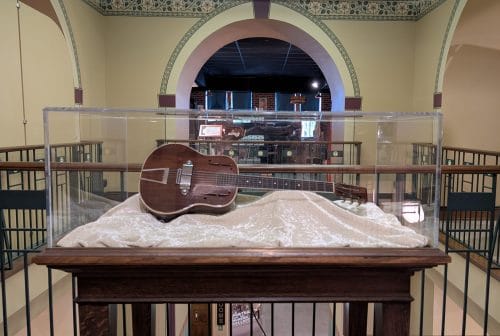
The actual guitar Brewer brought back to Wichita still exists, and the Wichita–Sedgwick County Historical Museum has helped preserve Wichita’s place in guitar history by sharing Brewer’s guitar alongside local music history and broader technological innovation.
Unfortunately, I think the exhibit is currently closed for Brewer’s guitar — having ended at the end of 2025!
Sources
If you made it this far — thank you so much! You are the reason I write this newsletter — and it would be nothing without you.
Would you please consider sharing this newsletter?
Thanks for reading and let me know if there is anything specific you would like to see going forward!
Best,
The Wichita Weekly
Reply